Django Reinhardt (1910 - 1953)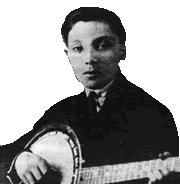
Django Reinhardt was born into the French Manouches
Gypsy tribe at Liberchies, Belgium, 24 January 1910.
His youth was pure adventure, as a gypsy, traveling
the country side and living in encampments close to Paris, France.
At the age of eight, his family settled near the
belt of fortifications that surrounded the old Paris, near the
Choisy gate. He played banjo, guitar and violin at an early age
and started playing professionally in Paris.
These French Gypsies or Manouches were a world unto
themselves, medieval in their beliefs, and distrustful of modern
science.
Django grew up in this world of contradictions, one
foot in the bustling big city of Paris and the other in the age-old
life of the nomadic gypsy.
Though born into poverty Django had the soul of
a nobleman and this natural elegance of bearing and attitude expressed
itself in his music.
When twelve years old he received his first instrument,
a banjo/guitar that was given to him by a neighbor who had noticed
his keen interest in music. He quickly learned to play, mimicking
the fingerings of musicians he watched.
Anecdotes concerning Django’s dexterity, memory,
and musical prowess began to circulate around other gypsy camps
and beyond. He seemed ableto turn his hand to any style but with
a passion for modern dance numbers his playing was most influenced
by Louis Armstrong and DukeEllington. He was soon astounding adults
with his ability on the guitar, and before he was thirteen he began
his musical career playing with popular accordionist Guerino at
a dance hall on the Rue Monge. He went on to play with numerous
other bands and musicians and made his first recordings with accordionist
Jean Vaissade for the Ideal Company. Since Django could not read
or write at the time "Jiango Renard" was how his name
appeared on these records.
On November 2nd, 1928 an event took place that would
forever change Django's life. At one o'clock in the morning the
18 year old Django returned from a night of playing music at a
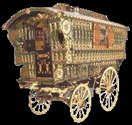
new club "La Java" to the caravan that was now the home
of himself and his new wife. The caravan was filled with celluloid
flowers his wife had made to sell at the market on the following
day. Django upon hearing what he thought was a mouse among the
flowers bent down with a candle to look. The wick from the candle
fell into the highly flammable celluloid flowers and the caravan
was almost instantly transformed into a raging inferno. Django
wrapped himself in a blanket to shield him from the flames. Somehow
he and his wife made it across the blazing room to safety outside,
but his left hand, and his right side from knee to waist were badly
burned.
Initially doctors wanted to amputate his leg but
Django refused. He was moved to a nursing home where the care was
so good his leg was saved. Django was bedridden for eighteen months.
During this time he was given a guitar, and with great determination
Django created a whole new fingering system built around the two
fingers on his left hand that had full mobility. His fourth and
fifth digits of the left hand were permanently curled towards the
palm due to the tendons shrinking from the heat of the fire. He
could use them on the first two strings of the guitar for chords
and octaves but complete extension of these fingers was impossible.
His soloing was all done with the index and middle fingers! Film
clips of Django show his technique to be graceful and precise,
almost defying belief.
Django was influenced by jazz recordings of Eddie
Lang and Joe Venuti, Louis Armstrong and Duke Ellington. This new
music found a place deep in Django's heart. It provided the perfect
vehicle for his prodigious talent for improvisation. Django rarely
if ever played a solo the same way twice. Numerous recordings prove
this to be true. His creative genius was not only that of the master
improviser, but also that of the composer, and he can be credited
with numerous pieces with beautiful melodies and sophisticated,
subtle harmonic structures. However, Django could not read or write
musical notation and he was at the mercy of others that could to
get his ideas down on paper.
1934 proved to be the most important year of his
life. The Quintet of the Hot Club of France was born! As the fates
would have it, the Quintet was formed by a chance meeting of Django
and Stéphane Grappelli. A band of fourteen musicians including
Django, Stéphane, Roger Chaput, and Louis Vola were commissioned
to play at the Hotel Cambridge at teatime. During intermission
Django would find a corner backstage and play his guitar. One day
Stéphane joined in and both were so pleased with the exchange
they went on to play together more and more frequently joined by
Roger Chaput (guitar), Louis Vola (bass), and eventually Django's
brother Joseph (guitar). A small record company Ultraphone recorded
their first sides Dinah, Tiger Rag, Oh Lady be Good, and I Saw
Stars. These first records caused a sensation! The Quintet went
on to record hundreds of sides and had a following on both sides
of the ocean.
1939 found the Quintet touring in England when the
war broke out. Django returned to Paris while Stéphane remained
in England. Django played and recorded throughout the war years
substituting Hubert Rostaing's clarinet for Stephen's violin. He
somehow avoided the fate of many of his kinfolk who went to their
deaths in the Nazi concentration camps. After the war he was rejoined
by Stéphane and they again played and recorded.
With the outbreak of war in 1939, the Quintet folded and Reinhardt
returned to his nomadic life, playing in various parts of Europe
and ensuring that he kept well clear of the German army. At the end
of the war (by which time he had switched from acoustic to electric
guitar), Reinhardt was invited by Duke Ellington to visit the USA
and duly arrived in New York. The visit was less than successful,
however. Some reports of the time suggest that Reinhardt was eager
to pursue the new concepts of jazz created by the bebop revolution:
musically, however, the guitarist's gloriously romantic style fitted
uneasily into the new music and his efforts in this field were overshadowed
by those of another guitarist, the late Charlie Christian. Back in
Europe he led his own small band and was occasionally reunited with
Grappelli in a re-formed Quintet. He continued to tour and record
during the late 40s and early 50s, simultaneously pursuing a career
as a composer. Reinhardt remains one of the outstanding figures in
jazz, and although Christian ultimately became the more profound
influence, echoes of Reinhardt's style can be heard today in many
musicians, some of whom were born after his death. His brother, Joseph,
was also a guitarist and his two sons, Lousson and Babik (b. 8 June
1944, Paris, France, d. 3 December 2001, Cannes, France), were gifted
players of the instrument. The latter died of a heart attack in December
2001.
On May 16th 1953 Django suffered a massive brain
hemorrhage and died, leaving behind his wife Sophie and son Babik.
His music remains as vital and exciting today as it was when he
lived, a legacy of joy to all future generations that rediscover
the genius of the Belgian gypsy Django Reinhardt.
(Most of the information is thanks to Joseph
Dinkins) |